
The Complete Beginner's Guide to Making Overnight Oats in South AfricaThis guide covers everything — from the master ratio to your first five SA recipes. By the time you finish reading, you’ll know exactly what to make tonight.
No cooking. No special equipment. Five minutes the night before. A breakfast waiting in the fridge when your alarm goes off.
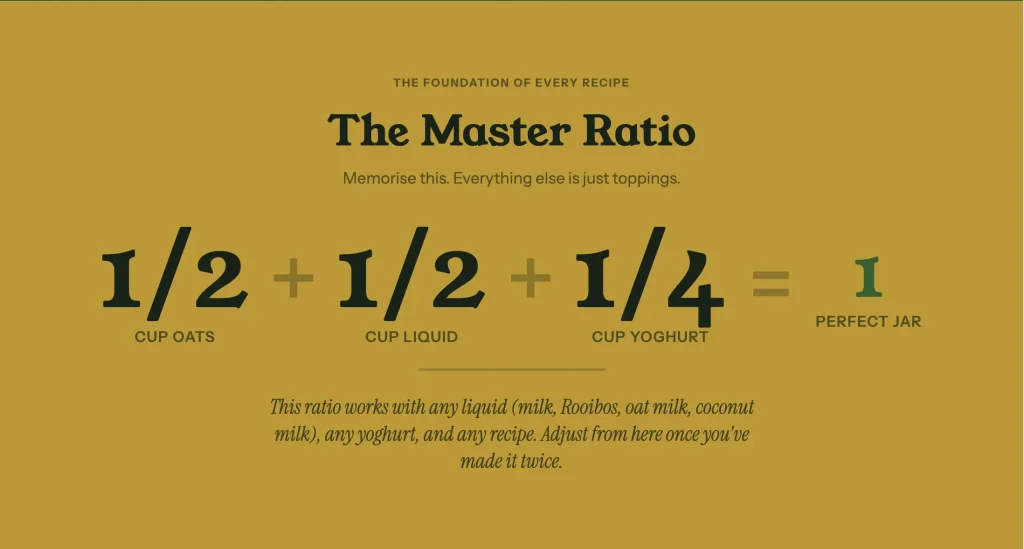
The Foundation of Every Recipe – The Master Ratio
Memorise this. Everything else is just toppings.
This ratio works with any liquid (milk, Rooibos, oat milk, coconut milk), any yoghurt, and any recipe. Adjust from here once you’ve made it twice.
1/2 Cup of oats + 1/2 Cup liquid + 1/4 Cup yoghurt = 1 Perfect Jar
Do I have to use Jungle Oats specifically?
No, but we recommend them because they consistently produce the best overnight oats texture available at SA supermarkets. Rolled oats from any brand work well. Woolworths rolled oats are an excellent premium alternative. The key is rolled oats not instant, not flavoured sachets.
Can I eat overnight oats every day?
Absolutely, and for most people, daily consumption is where the health benefits really accumulate. The beta-glucan fibre in oats has the most significant effect on gut health and LDL cholesterol reduction when consumed consistently over time. Vary your toppings and flavours to keep it interesting and ensure you're getting a range of nutrients across the week.
Are overnight oats good for weight loss?
They can support a weight management goal well. The combination of high fibre and protein keeps you full significantly longer than most breakfasts, which reduces mid-morning snacking. The key is watching your add-ins, a base jar is around 340–420 calories, which is appropriate. Adding extra nut butter, honey and granola can push it higher. Our Weight Loss recipe category uses lower-calorie add-ins and maximises the fibre and protein per jar.
Can I make overnight oats without yoghurt?
Yes. Simply use slightly more liquid to compensate try 3/4 cup liquid to 1/2 cup oats without yoghurt. The result will be slightly less creamy and you'll lose some protein, but it works well. All our Vegan recipes use this approach with coconut yoghurt or plant-based yoghurt as an alternative.
Can my kids eat overnight oats?
Yes, overnight oats are an excellent family breakfast. Children generally love the sweeter flavours: banana peanut butter, strawberry cheesecake, and mango coconut are all popular with kids. Adjust sweetness to your child's preference, and skip chia seeds for very young children (the tiny seeds can be a texture issue). Our Kid-Friendly recipe category has specific family-adapted versions.
Are overnight oats gluten-free?
Oats are naturally gluten-free, but they are frequently processed in facilities that also handle wheat, which can cause cross-contamination. If you have celiac disease or a serious gluten intolerance, look for certified gluten-free oats available from Faithful to Nature and Wellness Warehouse. Standard Jungle Oats are not certified gluten-free.
What's the difference between overnight oats and regular porridge?
Two key differences: temperature (overnight oats are cold, porridge is hot) and preparation time (overnight oats need zero morning time, porridge requires active cooking). Nutritionally, the cold soaking process in overnight oats actually increases the availability of beta-glucan fibre compared to hot-cooked oats so overnight oats are marginally more nutritious per gram. The texture is also completely different, creamy and pudding-like vs. hot and liquid.
—– step by step
How to make overnight oats.
Follow these six steps exactly for your first jar. By your second jar, you’ll have your own rhythm.
Choose your jar
A wide-mouth mason jar (450–500ml) is the gold standard — wide enough to layer ingredients, stir easily, and eat directly from. Any sealable container works. Glass is better than plastic for flavour, easier to clean, and more satisfying to eat from. A 500ml jar is the right size for one serving.
Add your oats
Measure 1/2 cup (about 45g) of Jungle Oats rolled oats into the bottom of your jar. Use rolled oats — not instant, not steel-cut for your first attempt. If you’re making a flavoured base (like Koeksister-Inspired), add your dry spices here too: cinnamon, cardamom, a pinch of salt.
Add your wet ingredients
Pour in 1/2 cup of liquid (milk, Rooibos, oat milk — your choice). Add 1/4 cup of plain yoghurt for creaminess and protein. Then add any liquid sweetener (1 tsp raw honey or maple syrup) and extracts like vanilla (1/4 tsp). If you’re making banana peanut butter, mash the banana in now and add 1 tbsp peanut butter.
Stir thoroughly
This is the step most beginners underdo. Stir everything together properly — scrape the bottom and sides of the jar, making sure every oat is coated in liquid and no dry pockets remain. It should look wet and combined, not like dry oats floating in milk. This is what produces the creamy, even texture that makes overnight oats so satisfying.
Seal and refrigerate
Close the lid tightly and place in the fridge. That’s it. Minimum 4 hours, ideally 8 hours (overnight). The oats absorb the liquid slowly, the yoghurt thickens the mixture, and the flavours meld together. The cold refrigerator does everything — no cooking, no checking, no timing required once the lid is on.
Top and eat in the morning
Open the fridge. Your breakfast is ready. Add your fresh toppings now — sliced banana, a drizzle of honey, fresh mango, granola, nut butter, or whatever your recipe calls for. Fresh toppings always go on in the morning — not the night before, or they go soggy. Give it one final stir if the oats look very thick, or add a splash of milk. Eat cold from the jar, or microwave for 90 seconds if you prefer it warm.
—– Equipment Guide
What you need. What you don't.
Good news: you almost certainly already have everything required. Overnight oats need zero specialist equipment.
ESSENTIAL🫙
Mason Jar or Sealable Container
The vessel. A 450–500ml wide-mouth mason jar is ideal. Any glass container with a lid works. Tupperware works. Even a large mug with clingfilm works for your first attempt.
ESSENTIAL 🥄
A Spoon
For stirring and eating. That’s it. A regular dessertspoon or a long-handled iced tea spoon works better for reaching the bottom of a tall jar. No other utensils required.
ESSENTIAL 🧊
A Refrigerator
The only “cooking” appliance overnight oats require. The fridge does all the work — no heat, no timers, no watching pots. Any fridge at any temperature setting works fine.
NICE TO HAVE ⚖️
Kitchen Scale
Measuring by weight (45g oats, 120ml liquid) is more consistent than cups. Not necessary for beginners, but useful if you want to track macros precisely or recreate a perfect batch.
NICE TO HAVE 🥄
Measuring Cups & Spoons
Standard SA measuring cups (1 cup = 250ml) make the ratio consistent every time. You can eyeball it after a few attempts — but precision helps when starting out.
DON’T NEED 🫕
Any Cooking Equipment
No pot. No microwave (for prep). No blender. No food processor. No stovetop. No oven. Overnight oats are cold-prepared. Any recipe that requires cooking first is not a true overnight oats recipe.
—– Your Evening Routine
A typical overnight oats evening
6:00pm – Open your fridge. Pull out oats, milk, yoghurt. Takes 30 seconds.
6:02pm – Measure, combine, stir. Everything into the jar. 2 minutes maximum.
6:05pm- Lid on. Back in the fridge. Walk away. Your work here is done.
7:00am – Breakfast is waiting. Open fridge. Add toppings. Eat. Go.
—– Timing & Storage
When to make it — and how long it lasts.
The timing flexibility of overnight oats is one of its most underrated features. You are not locked into making them exactly the night before — you have a comfortable window on both sides.
The minimum soak time is 4 hours — so even an early-afternoon prep still works for the next morning. The maximum useful soaking time before the texture begins to degrade is around 5 days in a sealed container.
Storage rule: Always store in a sealed container in the fridge. Never at room temperature — overnight oats are a dairy-containing product and should be treated accordingly. Add fresh fruit toppings in the morning only — not the night before, or they will soften and release liquid into the oats.
—– Troubleshooting
Something went wrong? Here's the fix.
Every overnight oats problem has a simple solution. Here are the most common ones — and exactly what to do.
😬
My overnight oats are too thick
This is the most common beginner issue — and the easiest fix. In the morning, add 2–4 tablespoons of milk and stir thoroughly. The oats will loosen immediately. If you used chia seeds, they absorb a lot of liquid — reduce by 1 tsp next time, or add more milk on the morning.
😞
My overnight oats are too watery / thin
You used too much liquid, or the oats didn’t fully absorb. Solution: add 1 tablespoon of chia seeds next time — they absorb 10x their weight in liquid and naturally thicken the mixture. Alternatively, reduce your liquid to 1/3 cup instead of 1/2 cup next batch.
🤢
They taste bland or flavourless
You under-seasoned. Two things fix this: always add a pinch of salt (it amplifies all other flavours dramatically), and don’t be shy with vanilla extract or spices. Double the honey next time. Salt in sweet food is not a mistake — it is the difference between bland and brilliant.
😵
The texture is mushy / gluey
You likely used instant oats (flavoured sachets) instead of rolled oats. Switch to Jungle Oats rolled oats — their cell structure holds up significantly better after an overnight soak. Instant oats are designed for hot cooking in 2 minutes, not 8-hour cold soaking.
😕
They’re not sweet enough
Add sweetener to taste — 1 tsp raw honey or maple syrup is the standard, but 2 tsp is completely reasonable. Using a riper banana (darker skin) rather than an underripe one also adds significant natural sweetness. Taste before sealing and adjust accordingly.
🕐
The oats are still crunchy / underdone
They didn’t soak long enough. Minimum 4 hours is required — ideally 8. If you made them in the morning expecting to eat them at lunch, give them more time. Also check: did you stir properly? Dry pockets that weren’t coated in liquid won’t absorb anything.
🍓
My fresh fruit went soggy
Always add fresh fruit toppings in the morning, not the night before. Berries, banana slices, mango chunks — all of these release liquid overnight and change the texture of the oats. Add them fresh when you’re ready to eat. The only exception: mashed banana stirred into the base (which is intentional).
🌡️
Can I eat them warm?
Yes, absolutely. Microwave for 60–90 seconds on medium power, stir, then add toppings. The texture changes slightly — it becomes closer to warm porridge — but it’s delicious, especially in winter. Remove the lid before microwaving. Do not use if your jar is solid metal.
—– Start Here
Your first five SA overnight oats recipes.
These five recipes are chosen specifically for beginners — each one teaches you something different about the base formula. Make them in order if you want a structured progression.
8 things every overnight oats beginner should know
🍌
Riper bananas = better oats
Wait for brown spots on the skin. Overripe bananas are significantly sweeter and mash more smoothly into the base.
🧂
Always add a pinch of salt
Salt amplifies every other flavour in sweet overnight oats. Even 1/8 tsp makes a noticeable difference. Never skip it.
☕
Sunday batch prep changes your week
Make 5 jars on Sunday evening. Monday to Friday breakfast is completely handled. 25 minutes of prep for 5 days of meals.
🌿
Chia seeds = instant thickness boost
Add 1 tbsp chia seeds to any recipe for a significantly thicker, pudding-like texture. No other changes needed.
🥛
Full-fat dairy = creamier oats
Full cream milk and full-fat Greek yoghurt produce noticeably creamier results than low-fat versions. If texture is important to you, go full-fat.
🍓
Fresh toppings in the morning
Bananas, berries, mango — always add fresh fruit in the morning. The night before and they go soggy and change the texture of the oats.
🔄
The ratio is your freedom
Once you know the 1:1 oats-to-liquid ratio, you can swap every other ingredient freely. The formula holds regardless of what you add.
🏷️
Label your jars
If you batch prep multiple recipes, put a sticky note or piece of masking tape on each jar. You will forget which is which by Wednesday.
—– FAQS
Every beginner question, answered.
Do I have to use Jungle Oats specifically?
No, but we recommend them because they consistently produce the best overnight oats texture available at SA supermarkets. Rolled oats from any brand work well. Woolworths rolled oats are an excellent premium alternative. The key is rolled oats not instant, not flavoured sachets.
Can I eat overnight oats every day?
Absolutely, and for most people, daily consumption is where the health benefits really accumulate. The beta-glucan fibre in oats has the most significant effect on gut health and LDL cholesterol reduction when consumed consistently over time. Vary your toppings and flavours to keep it interesting and ensure you're getting a range of nutrients across the week.
Are overnight oats good for weight loss?
They can support a weight management goal well. The combination of high fibre and protein keeps you full significantly longer than most breakfasts, which reduces mid-morning snacking. The key is watching your add-ins, a base jar is around 340–420 calories, which is appropriate. Adding extra nut butter, honey and granola can push it higher. Our Weight Loss recipe category uses lower-calorie add-ins and maximises the fibre and protein per jar.
Can I make overnight oats without yoghurt?
Yes. Simply use slightly more liquid to compensate try 3/4 cup liquid to 1/2 cup oats without yoghurt. The result will be slightly less creamy and you'll lose some protein, but it works well. All our Vegan recipes use this approach with coconut yoghurt or plant-based yoghurt as an alternative.
Can my kids eat overnight oats?
Yes, overnight oats are an excellent family breakfast. Children generally love the sweeter flavours: banana peanut butter, strawberry cheesecake, and mango coconut are all popular with kids. Adjust sweetness to your child's preference, and skip chia seeds for very young children (the tiny seeds can be a texture issue). Our Kid-Friendly recipe category has specific family-adapted versions.
Are overnight oats gluten-free?
Oats are naturally gluten-free, but they are frequently processed in facilities that also handle wheat, which can cause cross-contamination. If you have celiac disease or a serious gluten intolerance, look for certified gluten-free oats available from Faithful to Nature and Wellness Warehouse. Standard Jungle Oats are not certified gluten-free.
What's the difference between overnight oats and regular porridge?
Two key differences: temperature (overnight oats are cold, porridge is hot) and preparation time (overnight oats need zero morning time, porridge requires active cooking). Nutritionally, the cold soaking process in overnight oats actually increases the availability of beta-glucan fibre compared to hot-cooked oats so overnight oats are marginally more nutritious per gram. The texture is also completely different, creamy and pudding-like vs. hot and liquid.
Want a full week of better overnight oats? Our free 7-Day Overnight Oats Challenge delivers one complete recipe to your inbox every morning, with a full SA supermarket shopping guide for each one. Start tonight.
Made a better jar using these tips? Show us. Tag @OvernightOatsSA on Instagram with #MyOvernightOatsSA.